Monday, November 30, 2009

Magnificent

U2 @ Madison Square GardenImage by Clancy3434 via Flickr

That was FANTASTIC!

Metallica lacked the bottom, that visceral pounding on your chest that you get at a live gig. They proved conventional wisdom, that rock and roll doesn't work on TV.

I stumbled into last night's 25th Anniversary Rock & Roll Hall of Fame Concert during Paul Simon. When Crosby & Nash joined him to sing "Here Comes The Sun" I felt warm all over. I remembered playing the track two months after "Abbey Road" was released, when it finally stopped snowing after two days and the glowing orb emerged. George Harrison seems to have been forgotten, this was a fitting tribute. And it reminded us of a time when rock and roll drove the world, when nothing more important was happening than the Beatles.

Everybody took up a guitar. Everybody listened to the radio. We needed to get closer. This was no Facebook, this was something fully alive, that got inside and made you feel powerful, allowed you to transcend your problems, you just wanted to get closer.

And when Art Garfunkel came out and joined his old partner I marveled that "Sounds Of Silence" was a hit fully forty four years ago, at this exact time of year. To listen to the two men sing was to feel young and old at the same time.

Then the rockers hit the stage. Ray Davies was out of voice, the Lou Reed number didn't quite come together and Ozzy was hilarious but he looked younger than anybody on stage, having had way too much work. They all tried. But this was what it appeared to be, a special event, pairing buddies both old and new and leaving us...sadly somnambulant. We were watching TV, we weren't feeling TV!

Then came U2. "Vertigo" was botched so badly at first I wasn't even sure what song it was.

But one thing was clear. In this context, where you could see him, it was indisputable that Bono was a phenomenal front man. The moves, the words, they were beyond charisma. Charisma is what an actor has, something surface, something vapid. Whereas we want to get inside our rock stars, we want to see what makes them tick.

And when the number ended, Bono started to rap. About going to Yonkers, to Queens. But then he and his band took us higher than that, lifted us up over Madison Square Garden to the point we were hovering over the entire isle of Manhattan.

This was the treated guitar intro introduced on "Achtung Baby". The dark sound that dared us to come inside, to join the experience. And then the twiddling lead, like a blinking star in the sky inviting our attention. Then the rat-a-tat-tat of Larry Mullen, Jr.'s drums. Eventually I saw Vinnie Colaiuta pound the skins behind Jeff Beck, but I enjoyed Mr. Mullen more. Because just like Ringo, he perfectly complemented his band's sound. This was an attack, Larry was pounding bullets, imploring us, driving us forward.

And then Bono starts to sing like he means it. They're his words, not the rhymes of some hack in a back room. He was feeling it, and as a result we felt it too.

Everything I thought I knew was wrong. Not only soft music could work on TV, U2 was killing it! Unlike what had come before, this was not nostalgia, but alive and kicking. This was rock and roll!

Bono wasn't playing to the back row of a stadium, seeming miles away.

He wasn't playing for the YouTube audience.

He was playing just for us.

But it was better than that. He wasn't trying to convince the audience, he was showing the audience. That's what the Who specialized in, a veritable assault. You didn't nod your head and smile, singing along, your hair was blown back, you couldn't believe what you were seeing.

This number was brand new. But it fit perfectly in U2's canon, with "Sunday Bloody Sunday" and "Until The End Of The World".

Mick Jagger took the stage and one could see the lineage, of someone who took over and demanded your attention, Bono was in a long line...well, maybe a short line of commanding performers. And Fergie was better than could be imagined, but "Gimmie Shelter" never gelled, because unlike "Magnificent", it was never haunting, it lacked the ethereal quality of the original.

And Bono's duet with Mick fell flat too, the song just wasn't good enough.

But "Magnificent" was. I couldn't speak. My eyes were glued to the tube. I remembered what made me a believer.

From there it was downhill.

Until Sam Moore took the stage behind Bruce Springsteen's amalgamation and took a bizarre victory lap that rang so true, as he poured out "Hold On I'm Comin'" and "Soul Man".

But it's "Magnificent" that stuck with me. Because it encapsulated exactly Bono's description of rock and roll. Liberation!


Enhanced by Zemanta

COPYRIGHTS & WRONGS-A Guide to protecting your music....3

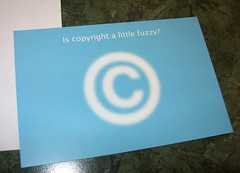
fuzzy copyrightImage by PugnoM via Flickr

REGISTER FOR CASH

Let's say you've composed a song, gotten it exactly how you want it, and have written it down or recorded it. It's not plagiarized and it has some creative spark. Under current U.S. copyright law, satisfying these criteria alone means you have a natural copyright and your work is protected. It's advisable, however, to register your song with the Library of Congress as soon as possible to establish a public record of it. In most cases, it must be registered before you can sue someone for infringement or collect compulsory mechanical-license royalties.

The Library of Congress Copyright Office classifies your new song composition as a Performing-Art Work. Fill out Form PA to register a musical composition only. This is useful for artists who are strictly songwriters. Send the completed form, a nonreturnable copy of your material and a $45 registration fee to the Library of Congress Copyright Office in Washington, D.C. For compositions, acceptable materials include a manuscript (lead sheet, full sheet music, or orchestrations) or a phonorecord (tape, CD, MP3 on disc). Make sure you include the entire song--everything you want protected--in your submission.

Your registration becomes effective when the Copyright Office receives it. In a few months you will receive a certificate of registration.

Those who are both writers and recording artists may register their composition and the accompanying recording at the same time and for one fee by using Form SR. In that case, you would send your song on a phonorecord only.

Also use Form SR to register sound recordings only (ideal for performers who don't write their own music). The application process and the fee per submission are the same as for musical compositions. Remember that the material you send for a sound recording must be a phonorecord and can't be a manuscript or audiovisual work such as a movie, music video or other multimedia format.

More tomorrow...

Enhanced by Zemanta

Wednesday, November 25, 2009

Jon Bon Jovi / John Mayer, What's The Difference

John Mayer 6Image by sushla via Flickr

If older folk still buy music and younger people steal it, why did John Mayer sell almost twice as many albums the first week out as Bon Jovi?

Yes, according to hitsdailydouble.com, John Mayer sold 301,204 copies of his new album, "Battle Studies", this week. Whereas last week, Bon Jovi moved 165,871 copies of "The Circle".

Ready for some truly horrifying news? This week "The Circle" fell all the way to number 19, selling 50,153 copies, a whopping drop of 70%. Whew!

What's the difference between John and Jon?

One is living in 2009 and the other is living in the last century.

Jon Bon Jovi was positively old media, tying in with NBC.

John Mayer was new media, appearing in concert on Fuse and tweeting up a storm.

It doesn't matter the total reach, it matters who actually watches and what the perception is.

Fuse would be canceled, the entire channel, if its programming was on NBC. To say the ratings are anemic would be charitable. But Fuse airs music, unlike MTV. And most people watching the shows featuring Bon Jovi on NBC don't give a shit about the man's music. In other words, Jon's shoving it down the wrong people's throats.

Jon Bon Jovi has a fawning documentary on Showtime.

John Mayer is all over Twitter.

Did you watch any of the Bon Jovi doc? Shot like it was footage for "America's Next Top Model", everyone looked beautiful and spouted humble platitudes, like we were still living in the eighties and rock stars were established on MTV and made a freaking fortune. Whereas the truth is everybody's scrambling, giving concert tickets away in some instances. Bon Jovi reflecting is like Lloyd Blankfein saying Goldman Sachs is doing "God's work". Huh?

Laughable.

If you Google "Bon Jovi Twitter", the first result is: http://m.twitter.com/backstagejbj a page that doesn't exist. The second result is http://twitter.com/bonjovimerch

Wow, someone in JBJ's camp doesn't understand Twitter. It's not for selling, its for CONNECTING!

Meanwhile, the Bon Jovi merch page has 1,540 followers.

Google "John Mayer Twitter" and you get the following page: http://twitter.com/jOhnCmAYer

John Mayer has 2,657,425 Twitter followers. Furthermore, he's following 72 people, so you get an idea of what he's into.

Bon Jovi's old school, playing behind a wall, just like Doug Morris and Jimmy Iovine, rarely coming out to play and only in circumstances they can control.

John Mayer is new school. Putting it all out there unfiltered, getting into arguments with Perez Hilton, never backing down, not afraid to look like a tool.

It's the honesty that grabs you. That's why people are following John Mayer, that's why they care about him. Furthermore, in an era where album sales represent only a fraction of your fan base, you want to get attention where you can. Not by batting people over the head, telling them they must endure you, but being so provocative, so interesting that they want to tune in.

Nobody plays the new media game better than Mr. Mayer.

He makes a deal with BlackBerry and it looks cool. Kind of like a rapper, ripping off the man, because you know he uses a BlackBerry anyway! Whereas U2 makes a deal with BlackBerry and you see dollar signs, you see promotion, you see a deal. If you endorse a product you truly use is it a sell-out?

The classic rock acts would probably say yes, you don't want to tarnish your image.

But Mr. Mayer is at the bleeding edge of a new paradigm, where the rules are being made up as we go. He's so overexposed that he's establishing a new way of doing it, you almost feel like he's a guy at your high school, that you know him. Does anybody really know Jon Bon Jovi? Who never has a bad word to say about anyone?

Old school: You're afraid of pissing anybody off, you're Justin Timberlake at the Super Bowl, apologizing.

New school: Dixie Chicks. Screw with me and I'll give you the middle finger.

In other words, it's been a long strange trip, but we're suddenly back in the sixties. It's about artistry, it's about music, it's about honesty. You don't triangulate, construct a phony identity for public consumption. You're better off being your real self. Hell, the Internet will tease out your flaws anyway, why not admit them?

Jon Bon Jovi utters irrelevant platitudes and John Mayer sings "Who says I can't get stoned?"

Politicians have to lie about doing dope. But artists are supposed to speak the truth, and the public has to deal with it. Which is why we love our artists more than any political figure.

"Who says I can't get stoned
Call up a girl that I used to know
Fake love for an hour or so
Who says I can't get stoned?"

A weird variation on drunk-dialing. Maybe her number is still in your cell. Maybe you've got to IM her, maybe you've got to pull up her Facebook page. But you're sitting at home, thinking about what used to be. Can you act on it?

That's a question confronting everyone online. Do you make contact or let the sleeping dogs of the past lie?

Bon Jovi, Mimi, all the stars of the MTV era are still living in it, oblivious to the fact that the nineties were ten years ago, and that in Internet time, a decade is equivalent to a century. It's not a three year cycle, you're on a day to day regimen.

"Any tweet that takes more than 90 seconds to write is not a tweet worth sending."

John Mayer

Yes, we used to make records in an afternoon and get them on the radio in a week. Now, TV and movies are more topical than music. Let it out, go knee-jerk, don't massage, don't focus on the marketing plan, focus on the music.

And stay in touch with your audience CONSTANTLY!

"Who Says": http://www.youtube.com/watch?v=FZwVjys2bQI


Enhanced by Zemanta

COPYRIGHTS & WRONGS-A Guide to protecting your music....2

No CopyrightsImage via Wikipedia

IN THE WORKS....

Musicians, songwriters, and recording artists typically encounter two types of copyrightable work: the first is the particular arrangement of notes and lyrics; the second is, the song itself. This is usually referred to as a musical composition, an underlying work (when referenced in relation to a sound recording), or just a song.

A song may have multiple writers, lyricists and arrangers, and the copyright can be split among them on a percentage basis. If you are writing with a partner or you involve others in your creative process, be sure to discuss early on how or if you will divvy up the copyright. Some songwriters assign all or a portion of their copyright to a music publisher who has agreed to market the song for them.

The second type of work you need to protect is the sound recording itself. A song may be recorded by any number of people so each recorded rendition is copyrightable. Even if you write as well as record the song, you need to protect your composition and your recording with separate copyrights. And, as with a musical composition, there may be others involved in the recording process, such as producers, who are entitled to a portion of the copyright. When an artist is signed to a record label, the label often retains the copyright of the master recording.

More tomorrow....

Enhanced by Zemanta

Tuesday, November 24, 2009

COPYRIGHTS & WRONGS-A Guide to protecting your music....1

fuzzy copyrightImage by PugnoM via Flickr

Well, the Music Publishing series went well and there were many responses clearly indicating that it is information that was useful and very much wanted. Today we will begin our series on Copyrights and Wrongs. There will be 7 editions to this series so keep a look out for them over the next 10 days, not counting the holiday coming up.

As an artist, your creative works are the lifeline of your business. By protecting them through copyright registration, you can control how they're used and ensure that you receive the income from them that you deserve.

To make the system function for you, you have to understand how it works. To that end, we'll explain a number of important music-copyright issues, such as what constitutes a copyrightable work, how to properly register a work, what rights you have if you're hired to write a song, and what happens to your copyright when you die. But remember, if you have copyright questions, consult a qualified attorney; this series should not be considered legal advice.

Just the fact...

In its most rudimentary definition, a copyright is actually personal property. But like trademarks and patents, a copyright is regarded as intellectual property, which is created from the minds of its authors. Copyright protection applies to literary works, musical compositions and recordings, dramatic works, choreography, and visual arts.

When you own the rights to a song, you control its use. Ownership gives you six exclusive rights: the right to make copies, creative derivative works and revisions, publish and distribute your creation, perform the work in public (or display it, in the case of visual art), and, in the case of sound recordings, perform it in public through a digital transmission (currently this refers to songs played on the Web). As an owner, you can even assign the whole copyright or shares of it to others.

For a song to be copyrightable, it must meet three criteria. First, your work must be fixed in a tangible form--it must be written down or recorded, so others can perceive it. Second, it has to be original, meaning that someone else hasn't already created it. And, third, it must demonstrate at least a modicum of creative expression...


More tomorrow.....

Enhanced by Zemanta

Saturday, November 21, 2009

Bon Jovi Circle

Cover of "Lost Highway"Cover of Lost Highway

How do we want to spin this? That few want Bon Jovi's new music or NBC is in the crapper?

Yes, follow the stories. NBC/Universal may end up being controlled by Comcast. This has got more to do with Vivendi exercising an exit clause than NBC sucking, but the network does. Blame it on Jay Leno at 10 or a general lack of creativity, but the ratings are terrible, the network is far-removed from the leaders of the pack, just like Bon Jovi is far-removed from the audience.

Jon Bon Jovi even did the Actors Studio. I guess it speaks more to the lost credibility of James Lipton than the becoiffed one's lack of a distinguished film career, but still...what's next? Bon Jovi suiting up for the Jets? Or the New England Patriots?

You've got to give us a reason to care. And most people don't anyway. So, you're speaking to your core audience at most, and it turns out these people don't want new Bon Jovi music, they just want to hear that Tommy used to work on the docks.

In case you missed the memo, "Circle", with all its shenanigans, the incredible hype, the $3.99 offer, sold 163,000 copies last week. Which might sound somewhat impressive, since the album debuted at number one, but their 2007 country effort, "Lost Highway", also entered at the top of the chart, yet it sold 292,000 copies! Meaning that even though they were selling out, being crass commercial marketers, going country was a better idea than playing the mainstream game. Sure, sales have dropped in the past two years, but not THIS much!

Bon Jovi got it all wrong. They should have put out ONE song. Woodshed until they got one right. Then licensed this one cut to the NFL or ESPN and had it banged ad infinitum. Most of the NBC hype fell on deaf ears. Today's story is we avoid anything we're not interested in. We had to sit through Bon Jovi on MTV in the eighties, today we flip the channel or surf to another site.

Speaking of sites, Bon Jovi even advertised on CNN!

Who took the band's money? Who is so out of touch with today's market conditions? In a time of upheaval you don't play by the old rules, you revolt and do something completely new. And believe me, lining up with a major TV network is positively last century. That shotgun approach, hit everybody and hope they're interested, leaves you with a ton of wasted impressions, people who don't give a shit.

It's all about the tour. That's where the money is. So, I'd juice up the tour. Whether it be by playing "Slippery When Wet" from start to finish, the only album people truly care about, or creating a live extravaganza like Kenny Chesney's multi-bill stadium shows. Every hair band come back to life! You know the female Bon Jovi audience, the act's main driver, loved Slaughter and Cinderella and Winger and White Lion too...

And where's the online contest? Find the right clues, and you get a song written just for you, the winner!

Where's the promotional tour where you show up at diehard winners' houses? Yup, you compete online and then Jon and Richie show up unannounced, like the Publishers Clearing House, and perform "Wanted Dead Or Alive" in your living room.

And speaking of "Wanted Dead Or Alive"... Where's the live rendition from Phil, from "Deadliest Catch"? With a video to match? This barely alive skipper with a Marlboro habit should be featured, just like the song that leads off this series so well.

In other words, where's the creativity? Shit, Josh Freese got more ink and had more penetration of the public consciousness with one good idea than Bon Jovi achieved playing by the old rules.

Because creativity rules. And when you get to superstar level, the acts are creatively bankrupt. Just playing by the old rules, looking for a paycheck. Even though so many broke the rules in order to achieve their success.

You've got to risk. You've got to take chances. You've got to realize we live in 2009, not 1989.

Used to be music was the cutting edge artistic medium. Then, you had a better chance of seeing present-day reality in "Law & Order" than hearing it on a record album. Shit, "South Park" still takes chances. Why can't Bon Jovi?

The best Bon Jovi bit of the last ten years, eclipsing all of their music, was their interview with Triumph the Insult Comic Dog. Why didn't they have Triumph do their new interview? Make a deal with YouTube to get it on the home page?

As for the album itself... It may trigger a revenue-producing event, but it's a circle jerk between the act and the label. It's about music. Create some music that we truly want to hear, that we can sink our teeth into. Otherwise, it's all just marketing. And you can't sell what the public doesn't want.

Bon Jovi and NBC Universal Team Up For First-Ever Artists In Residence Project: http://www.nbc.com/news/2009/10/15/bon-jovi-and-nbc-universal-team-up-for-first-ever-artists-in-residence-project/

Triumph the Insult Comic Dog: http://www.dailymotion.com/video/x1z09v_triumph-the-insult-comic-dog-bon-jo_animals


Enhanced by Zemanta

Paper Sheds New Light On Music Listening Habits

iPod sales chart from launch till june 2008 in...Image via Wikipedia


A good friend of mine shared this information with me and it was important enough to share with you. I field 100's of questions a day asking the big question, "how important is radio today?" Here are some facts you can use as you try to determine your various strategies on promoting your next single.


Paper Sheds New Light On Music Listening Habits
November 03, 2009 -
Digital and Mobile
By Glenn Peoples,

Nashville: A new paper by Council for Research Excellence (CRE) with support from the Nielsen Company dispels many of the myths about how people today listen to music. From broadcast radio to MP3 players, some popular notions about listening in the digital age appear to be horribly off the mark. "How U.S. Adults Use Radio and Other Forms of Audio" is the result the tracking of 752 days of audio media usage of participants in five markets -- Atlanta, Chicago, Dallas, Philadelphia and Seattle - in parts of Spring and Fall of 2008. The study includes both users and non-users of media devices.

Myth: People don't listen to the radio anymore. According to the study, broadcast radio by far has the broadest reach and commands the most listening time. Broadcast radio has a 79.1% reach and gets an average of 122 minutes per day from listeners.

Myth: Young people don't listen to radio less than older adults. The CRE found that 79.2% of listeners from 18 to 34 listen to broadcast radio, and they average 104 minutes per day. Radio's daily reach amongst younger listeners is only slightly lower than its 80.6% amongst 35 to 54 year olds. That older group averages 107 listening minutes per day - just three fewer than younger listeners.

Myth: Nobody listens to CDs anymore. CDs and cassette tapes are second in reach (behind broadcast radio) and get an average of 72 minutes per day from users. CDs represented 16.1% of daily listening time in the study, over twice that of satellite radio and over three times the share of portable MP3 players. CD listening is higher for consumers with lower incomes and less education. However, the reach of CD listening is the same whether or not the listener is technology oriented.

Myth: Young people are over CDs. Young listeners actually listen to CDs more often than older listeners, according to the study. Just under half the 18 to 34 age group listen to CDs every day, and they average 78 minutes per day. Only 36.2% of the 35 to 54 group listen to CDs daily, and they average just 74 minutes per day. Myth: The iPod has killed off radio and CDs. Portable MP3 players had only an 11.6% daily reach and a 4.9% share of all audio. Even among the 18 to 34 age group, MP3 players account for only 7.5% of each day's listening time.

Myth: The computer is the new stereo. Only 10.4% of the sample used their computers to listen to a digital file while only 9.3% streamed audio on their computers.
Myth: The Internet is where people discover music. The two ways to listen to music on a computer - a saved file or streamed audio - represented very little of the study's listening hours. Files accounted for only 4.1% of the study's total daily listening. Streamed audio amounted to only 3.8%. The daily reach of each was about 10%.

Myth: The digital crowd has given up on other formats. Over four-fifths of people who listen to MP3 players listen to broadcast radio and they average 97 minutes per day. People who stream audio on their computers average 98 minutes of broadcast radio per day.


Enhanced by Zemanta

Friday, November 20, 2009

CAN I SEE YOUR LICENSE - MUSIC PUB SERIES

RoyaltiesImage via Wikipedia

When you finally get a call from a company wanting to use one of your sopngs, you'd better have your license forms ready to do business. Prepare all the license forms you expect you might need ahead of time, leaving particulars such as signatory names, song titles, dates, royalties and fees blank. They'll be fiolled in following negotiations.

A mechanical license is used to authorize phonorecords of a song to be recorded and distributed. You'll want to prepare a separate mechanical license for authorizing digital phono record delivery, also known as Internet Download.

You'll need two different forms of streaming licenses to authorize streaming songs on the Internet: one for fee-based streaming on demand, and the other fro promotional streaming such as that used by recording artists on MySpace. A master-use license permits all or some of a demo's recorded track to be used in a new recording or placed in a film or on TV. You'll also need to prepare separate synchronization licenses (permitting the song to be synchronized to picture) for placements in film, TV, and commercial advertisements. Additional licenses include those for use of your songs in video games and ring tones.

You could have a music-business attorney draw up these documents, but it'll likely cost you thousands of dollars, especially if license terms need to be tweaked during negotiations. A good entertainment lawyer typically charges between $150-$750 per hour. Anyone can learn to understand and write the legalese required to fashion their own licenses, by studying the right books. Remember in our last session "A Good Education" is my recommendation on required reading.

Once one of your songs is recorded, you'll need to register it with your PRO. If you don't they won't know who to pay performance royalties to when the song title appears in their sample surveys of radio broadcasts and the like. Go to the PRO's web site to download the proper registration form.

More on Monday....


Enhanced by Zemanta

TAYLOR SWIFT RESPONDS

Fearless (Taylor Swift album)Image via Wikipedia


First time I was in the shower. When I listened to the message toweling off, I thought she said "Erica". Listening again it was clear it was Ms. Swift, who sounded troubled, like there'd been a misunderstanding involving love. And maybe that's the case. She felt I loved her, had I turned against her?

That's what she said when we finally spoke. That she thought I got her. And it frustrated her to think that I believed she used auto-tune.

She denied it. Emphatically. As only as a nineteen year old can. I believed her. But it still didn't address the underlying issue. Could she sing? Exactly how good a singer was she?

I told her I couldn't talk right now. That I was rushing out to a doctor's appointment. If she wanted, we could speak about two hours hence, when I came back. But there was the eight hour time difference, and the day was evaporating. Although she'd left me her cell phone number, unfortunately one digit eaten by the machine, I told her to e-mail me with her address, and as soon as I got home I'd let her know, we could talk.

But then doing the math, worried we'd be unable to connect, having to get up early to do interviews, Taylor got into it. How she didn't even know how to use auto-tune, had never used it. Then again, she admitted to fixing some mistakes in the studio.

Then I asked her, what about those high-priced concert tickets online? What was going on there? I'd printed an e-mail saying in Philadelphia that tickets were going for far in excess of a hundred bucks and then, within minutes of my publishing said letter, the whole tour page disappeared online, replaced with dates that had already played as opposed to those coming up.

She told me she had no idea. She'd have to check into it. And I ran out of my house and got behind the wheel.

This was not the first contact I'd received from her camp. I'd gotten a long e-mail from her father. Not histrionic, not criticizing me, but also emphatically denying she'd been auto-tuned live. That was off the record, but now since his daughter has weighed in...

And maybe that was true. Because she was so horrible in the opening of the CMAs. Oh, that's a strong word to use. It's just that she was so far from perfect, anywhere but on the note, on pitch. She was definitely naked there.

As she was during the first song on SNL. Not the opening segment, wherein Taylor said, like many writers to me opined, that she was trying to imitate Phoebe from "Friends", but the full band number. She wasn't quite as bad as she was on the CMAs, but she was not up to the level of a professional. The second song was better, but the backup vocals were covering up quite a bit.

So, like I said. Even if she didn't use auto-tune, there was still the underlying issue, could she sing? She admitted fixing things on record...

Then, after my appointment, I got an e-mail from the guy who leases the audio equipment for her tour, one Everett Lybolt, GM of Sound Image. This was pushing me over the edge. They protesteth too much! Furthermore, Mr. Lybolt went on to criticize other performers on the CMAs for not being live.

Who the fuck knows.

Taylor said I could come to the gig, check all her equipment out.

Like I'm really going to do that. Like it would prove anything. And I never wanted to be a member of the CIA.

And then I get home to a hanging tag from FedEx. My new laptop has finally arrived from China. I missed the delivery by fifteen minutes. I call the delivery service, asking for a resend, and while I'm being transferred between operators, another person is looking for me. But they hang up, then ring again. It's Taylor. Who I tell to hold.

This was unexpected. I figured she'd accomplished her mission.

But she wanted to get back to me with information on the tour dates. As a reader had informed me, the Wachovia Center in Philadelphia does not use Ticketmaster, Comcast sells the tickets. And isn't it funny now that Comcast has joined the Ticketmaster/Live Nation cluster fuck, with Irving supposedly offloading assets to the Roberts-controlled venture so the merger can go through.

Taylor told me her site had been hacked. That the link should have been to comcasttix.com. But the hackers had redirected buyers to gotthetix.com. That's why ducats for her show were priced far in excess of a hundred dollars. She implied that this had been discovered days ago, but in any event, she said it had now been fixed. Anyway, if you go back to her tour page now, the spring dates have reappeared. With Philadelphia and most other markets being shown as being sold out.

The truth?

Who the hell knows.

But there's your story.

But what about our earlier conversation. About Taylor's singing?

I told her she was quite good in the skits on SNL. And she was. Best non-actor guest host in recent times. But I told her, like that CMA opening, the first song...her voice was not good.

Taylor laughed. Said she could handle being criticized for having a bad voice, for missing notes. But she couldn't live with being criticized for being inauthentic.

Those songs are written in real time. About real people. Her co writers edit more than contribute. Her next album she's not planning to write with anyone. Not now, anyway.

And speaking of collaboration, she said she's got no manager. That she and her team have weekly meetings, where they go over career details. If she's on the road, she's conferenced in. The decisions are hers.

Like playing Gillette Stadium?

Absolutely. It's something she always wanted to do. She figures she'll do two or three stadium gigs next summer, that's all. She's salivating over building the show, deciding who will appear with her.

As for SNL, the call came through William Morris. They phoned and told her to hold for Lorne Michaels. Her heart was palpitating, she didn't figure it was about hosting SNL, and when she got the word, she was flying.

Then we discussed her career. And music.

I felt I was getting some stock answers. As I listened, I put myself in her shoes, wondered what it must feel like to get asked the same damn thing again and again. But I wanted to know. Did she see herself as a singer, an actress or..?

Definitely a singer. With a body of work that delineated the various periods of her life. Her first album was about being 13-16. Her second...

So I asked her what her favorite album was. Not because I was making a list, but because I wanted to know where she was coming from.

She thought for a moment, then said Shania Twain's "Come On Over".

I said Mutt Lange was the best living record producer, a true master. But had she ever listened to Joni Mitchell?

There was some hesitation. Then Taylor said no.

I told her to buy "Blue" tonight. Quoted her some lines from "A Case Of You".

And quoting that classic number, I went on to recite lines from Jackson Browne's "The Late Show". Told her I didn't want to overload her, but she should buy "Late For The Sky" too.

Taylor told me she'd seen Jackson live acoustic.

I guess I wanted to know if Taylor Swift wanted to be a star or an artist. That's why I wanted to know her favorite album, I wanted to know her hopes and dreams. Did she need to be in the spotlight, or was it about the work, testing limits?

She's the one who's got to figure it out.

Right now, she's the biggest star in America. Trumping U2, Springsteen, even Kenny Chesney and the Stones. And it's all based on these songs. Straight from the heart. That's why the little girls relate.

One day those girls will be women. A cusp where Taylor Swift is presently residing. Will she make the wrong choices?

I told her you can't say yes to everything. You can make some mistakes, but too many wrong steps can crimp your career.

Then again, I'm fifty six and she's nineteen. Growing up is about taking chances, making mistakes. But I didn't want her to listen to oldsters, telling her what to do, telling her it didn't make any difference as they skimmed from her pond.

We talked about Louis Messina and American Express. This was not some backwoods bimbo, an uneducated nitwit who was clueless when it came to business, but she knew only so much of the inner workings. But that which she did speak about she had a command of. When I broke new ground, she could follow. Taylor Swift is smart.

So where does that leave us?

Did Taylor Swift work me?

I've been worked before. I recognize it when I see it. Tommy Lee insisting I print his e-mail before he responds again. He was looking for publicity. Taylor seemed to need set the record straight. For herself.

Then again, there's an entire career in the balance.

But songs trump singing all day long. Anybody can sing, especially in this auto-tune era. But being able to write a great song, one that grabs fans lyrically and melodically, that's truly tough. And Taylor Swift has accomplished that.

So, I'm a huge fan of the albums.

And I'm convinced she's vocally challenged. But the way Taylor handled that in our conversation, by not skipping a beat, by admitting she's less than perfect, that she can handle the criticism, won me over.


Enhanced by Zemanta

Thursday, November 19, 2009

A GOOD MUSIC EDUCATION IS PRICELESS

Cover of "All You Need to Know About the ...Cover via Amazon

To be successful, a music publisher must be thoroughly educated about the complexities of the music business. Here are three books I recomend:

All You Need To Know About the Music Business, 6th ed., by Donald S. Passman (Free Press, 2003). This is a must-read for music publishers, especially those who are also performing musicians or aspiring recording artists.

Music, Money and Success, 5th ed., by Jeffrey Brabec and Todd Brabec (Schirmer Trade Books, 2006). Reviewed in November 2007 issue of EM, this is the most comprehensive reference book for music publishers and other industry professionals I've read to date. The last chapter contains five sample contracts.

This Business of Music, 9th ed., by William Krasilovsky and Sydney Shemel (Billboard Books, 2003). Considered by some to be "old school" and short on dollars-and-sense advice, this book never-theless includes excellent chapters on copyright law.

We have 3 more segments to complete this music publishing series. Following that we will begin a series on Copyrights and Wrongs and for those of you interested in our real estate series, we will do that simultaneously.

If you have friends that are on your MySpace, FB or Twitter pages and feel that they would benefit from this series, please feel free to email them with a link to share this valuable information with them at http://composer62.blogspot.com

More tomorrow....

Enhanced by Zemanta